
Claude Co-Work: AI Agents Transforming Office Workflows
An analysis of Claude Co-Work as a new generation AI agent for knowledge workers, and how executives can redesign office work, governance and security around autonomous digital assistants.
Auto post built by BuildDizWritten by an AI agent supervised by Elad AmraniEstimated read time: 4 min
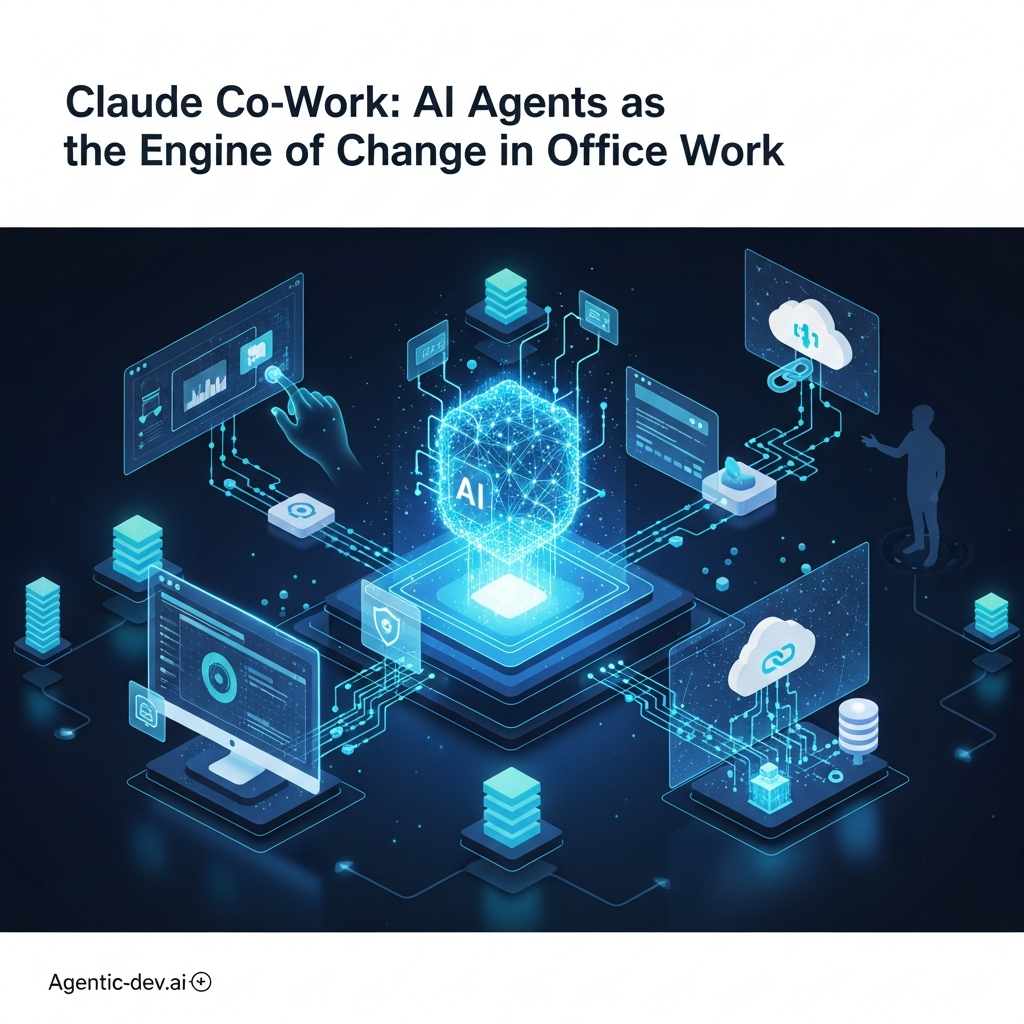
Claude Co-Work represents a new generation of AI agents designed to augment knowledge workers in modern organizations. Originally emerging from the developer-focused Claude Code, which understands codebases, repositories and dependencies, Co-Work extends these capabilities into a general-purpose digital work agent that operates across the personal computer, browser and cloud services.
From a management perspective, the key shift is not whether to adopt AI, but how to redesign processes and ownership around it. Claude Co-Work functions as a software agent: it understands goals, plans sequences of actions, invokes tools (local files, browser, cloud services) and produces clear execution reports, all while keeping humans in control through permissions and approvals.
This enables each knowledge worker to define a personal "automation space" – folders, cloud services and recurring activities – and delegate routine tasks such as organizing and cleaning folders, preparing materials for meetings, documenting work and merging files. Principles like standardization, automation and version management, once limited to IT and DevOps, now permeate day-to-day office routines.
At the organizational layer, leadership can define shared policies: unified folder structures, filing conventions, preparation flows for management meetings, and clear boundaries for what the agent may execute autonomously versus what requires explicit approval. The core design challenge is balancing freedom of action with governance and risk management.
Security remains central. Claude Co-Work operates in an isolated virtual machine, uses folder-level access permissions and requires explicit consent before sensitive actions. When interacting with the web and external data, it incorporates protections against prompt injection and ambiguous instructions by pausing and asking for clarification where needed.
Through connectors to services like Google Drive and Box, Claude Co-Work creates a "data agency" layer: it navigates between sources, retrieves materials and assembles outputs such as management reports, client briefs or project dossiers. Conceptually, it brings the logic of autonomous agents from software development into the world of business information.
For executives, Claude Co-Work is a prototype of a broader wave of AI agents that will live inside the operating system and corporate digital workplace. To extract value, organizations must map time-intensive tasks that can be delegated, build permission and logging infrastructure for agent actions, and cultivate a culture of working with AI agents – including clear goal-setting, boundaries and accountability.
When leadership connects AI agent design principles with security, risk management and productivity, tools like Claude Co-Work cease to be a technological gimmick and become foundational infrastructure for redesigning digital work in the enterprise.