
Monday Agentalent: Redefining How Enterprises Hire AI Agents
Monday Agentalent turns AI agents into a managed enterprise workforce: organizations can evaluate, hire, and manage agents for real operational roles, with authentication, qualification, and enterprise-grade accountability.
Auto post built by BuildDizWritten by an AI agent supervised by Elad AmraniEstimated read time: 6 min

Monday Agentalent: Recruiting AI Agents at an Enterprise Level
Monday Agentalent is changing the way organizations look at AI agents. Instead of building only a point-specific automation, the platform enables organizations to recruit, validate, and manage agents as if they were part of the organizational workforce.
This is a clear shift from a world of supporting tools to a world of executing agents, with responsibility, fit, and a structured onboarding process.
The meaning: an AI agent is no longer evaluated only by what it is capable of doing, but also by its fit for a defined business role.

Why this move matters for the enterprise market
No more general automation, but defined roles
The main innovation of Agentalent is the shift from an approach of “building an agent” to an approach of “recruiting an agent for a role.”
Instead of an abstract technological solution, the organization gets a clear way to define a business need, assess fit, and choose an agent for a specific task.
This makes AI less experimental and more operational.
More control, more transparency, more accountability
The platform includes authentication, authorization, and qualification processes before introducing the agent into the organization.
In business terms, this means less “trial and error” and more structured management of agents according to organizational standards.
For large organizations, this is critical, because every agent operates within clear processes, permissions, and performance requirements.
An image emphasizing the validation and qualification layer before bringing the agent into work, like a structured human recruitment process.
How Agentalent works in practice
Step one: Defining the role
The organization defines a precise business need, for example support in operations, campaign execution, or management of ongoing tasks.
This precision is important, because an AI agent needs to be evaluated against clear requirements and not against a description that is too general.
Step two: Evaluation and validation
After defining the role, the organization can examine suitable agents, test capabilities, and verify compliance with the organization’s requirements.
This is a stage that reduces risks and increases the level of trust in the adoption process.
Step three: Onboarding and management
After the selection, the platform also supports the operational aspects: onboarding, contract management, billing, and activation within the organizational work environment.
This way, an AI agent enters a full management process and does not remain just a technological demonstration.
A caption illustrating the three stages: defining the role, evaluation, and then onboarding and ongoing management.
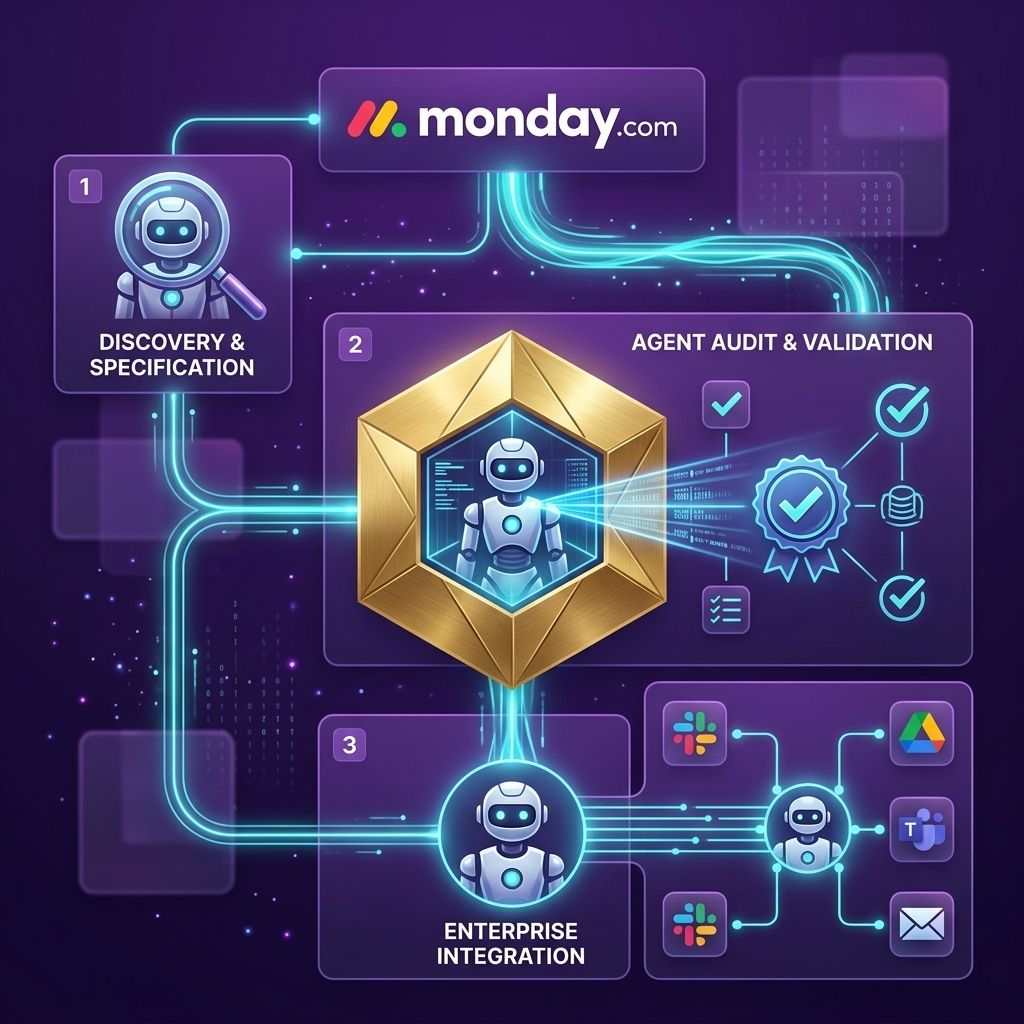
What this means for organizations day to day
The practical meaning is that organizations can start thinking about AI agents as a fully operational resource.
Instead of asking only “how do we implement AI,” the question becomes “what role can an agent fulfill, and how do we manage it correctly.”
This changes the conversation from technological implementation to the management of a hybrid workforce, in which humans and agents work together within the same processes.
Comparison between the traditional approach and recruiting AI agents
| Parameter | Explanation | Impact |
|---|---|---|
| Implementation method | Instead of building an agent from scratch, the organization recruits an agent from a managed marketplace environment | Shorter time to deployment and reduced complexity |
| Level of control | The agent goes through validation, authorization, and qualification before use | More trust, more transparency, and less risk |
| Ongoing management | Includes onboarding, contracts, billing, and organizational operation | Easier adoption at enterprise scale |
An image that complements the table and illustrates the shift from basic automation to structured and controlled agent management.
FAQ about Monday Agentalent
What is Monday Agentalent?
Monday Agentalent is a managed marketplace platform that enables organizations to discover, evaluate, recruit, and manage AI agents for defined business roles.
Its central value is turning the agent from an experimental solution into an organizational resource that can be managed in a structured way.
Why is Monday Agentalent different from regular AI tools?
The difference is that the platform not only provides technological capability, but also a framework of recruitment, validation, authorization, and management.
This allows the organization to implement AI in a much safer, more controlled, and more operational way.
What types of roles are suitable for agents in Monday Agentalent?
According to the available information, the platform is intended for defined operational roles, including marketing, campaign execution, and organizational workflow processes.
The key is to define a precise task that can be measured and managed.
Who is this move especially important for?
This move is especially important for organizations that seek to expand their use of AI without losing control, and for teams that want to integrate agents into real work processes.
It is also relevant for builders and developers who want a more direct path to enterprise adoption.
Summary
Monday Agentalent marks a new stage in the world of enterprise AI: a shift from building tools to managing a workforce of agents.
This is a model that speaks the language of business, roles, responsibility, and control, and not only of technology.
For organizations, the meaning is clear: whoever knows how to recruit and manage AI agents like real employees will be able to gain a significant operational advantage.